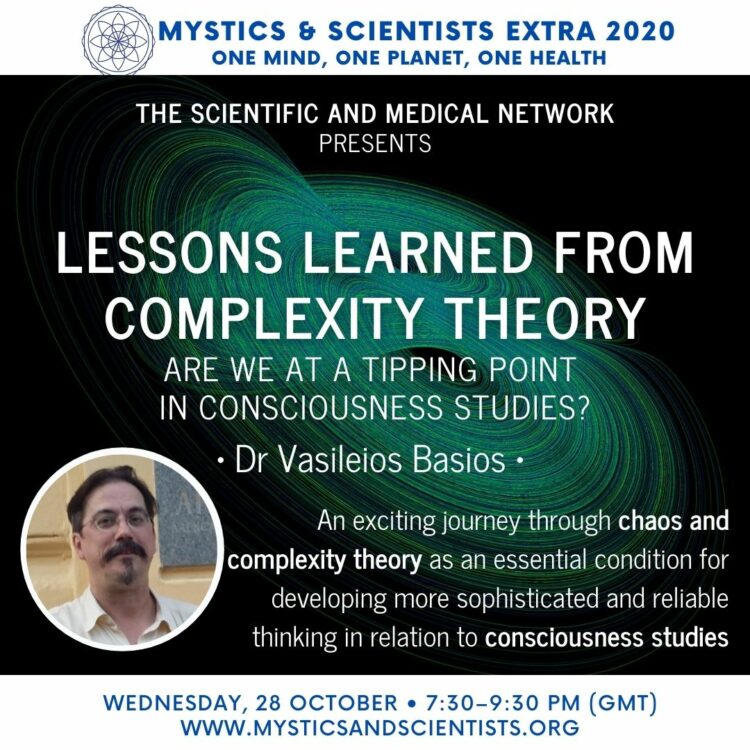
Vasileios Basios – Lessons Learned from Complexity Theory: Are We at a Tipping Point in Consciousness Studies?
How can we relearn organisation through self-organising systems?
Join Dr Vasileios Basios for an exciting journey through chaos and complexity theory as an essential condition for developing more sophisticated and reliable thinking about the processes of change and transformation in relation to consciousness studies.
The breakthroughs of modern science always point way beyond its own conceptual framework. However, we have not yet come to terms with their significance as to how to incorporate these new horizons in how we think, act and learn. Although Complexity Theory highlights the importance of non-linearity, we still try to solve our non-linear problems with linear thinking. Although wholeness informs modern science, we still try to fix the parts via mechanically informed concepts, either at the level of institutions of at the level of individuals. We know now, from Chaos Theory, that determinism does not imply necessarily predictability and that strong tipping points and crises announce themselves through weak signals, yet we stick into anticipating the big trends. In order to navigate safely through a complex and changing landscape, we must re-learn organisation from self-organising systems and adaptation from self-adaptive systems; and stop thinking about wholes as mere sums of parts.
Speaker
-
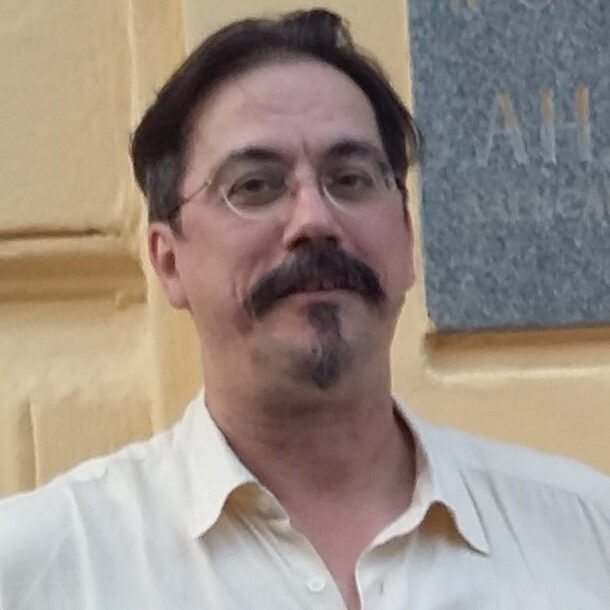 Vasileios BasiosPhysicist, Senior researcher
Dr Vasileios Basios is a senior researcher in the Physics of Complex Systems at the University of Brussels, with over 25 years of experience in research and coaching. His interdisciplinary work focuses on self-organisation, emergence in complex matter, complementarity and the foundations of complex systems. Mentored by Nobel laureates Ilya Prigogine and Grégoire Nicolis, Dr Basios received his Ph.D. from the University of Brussels after studying cybernetics with John S. Nicolis. His research interests include foundations of complexity science, emergence in complex matter, nonlinear dynamics and chaos in biological information processing, computability and the logic of extended Bayesian inference.
He is deeply interested in the history of scientific ideas and their role in transforming science beyond the mechanistic worldview. His work aims to bring insights from complex systems science to consciousness studies, working towards an inclusive and self-reflexive interdisciplinary science of consciousness. In 2023, his research team received the inaugural Linda G. O’Bryant Noetic Sciences Research Prize for their study on detecting deviations from random activity as indicators of nonlocal consciousness correlates beyond the brain. By contributing to complexity and consciousness research in a variety of formats, from podcasts to books to peer-reviewed papers, he aspires to advance knowledge in this evolving field.

Recent Book Reviews




Random Book Review