
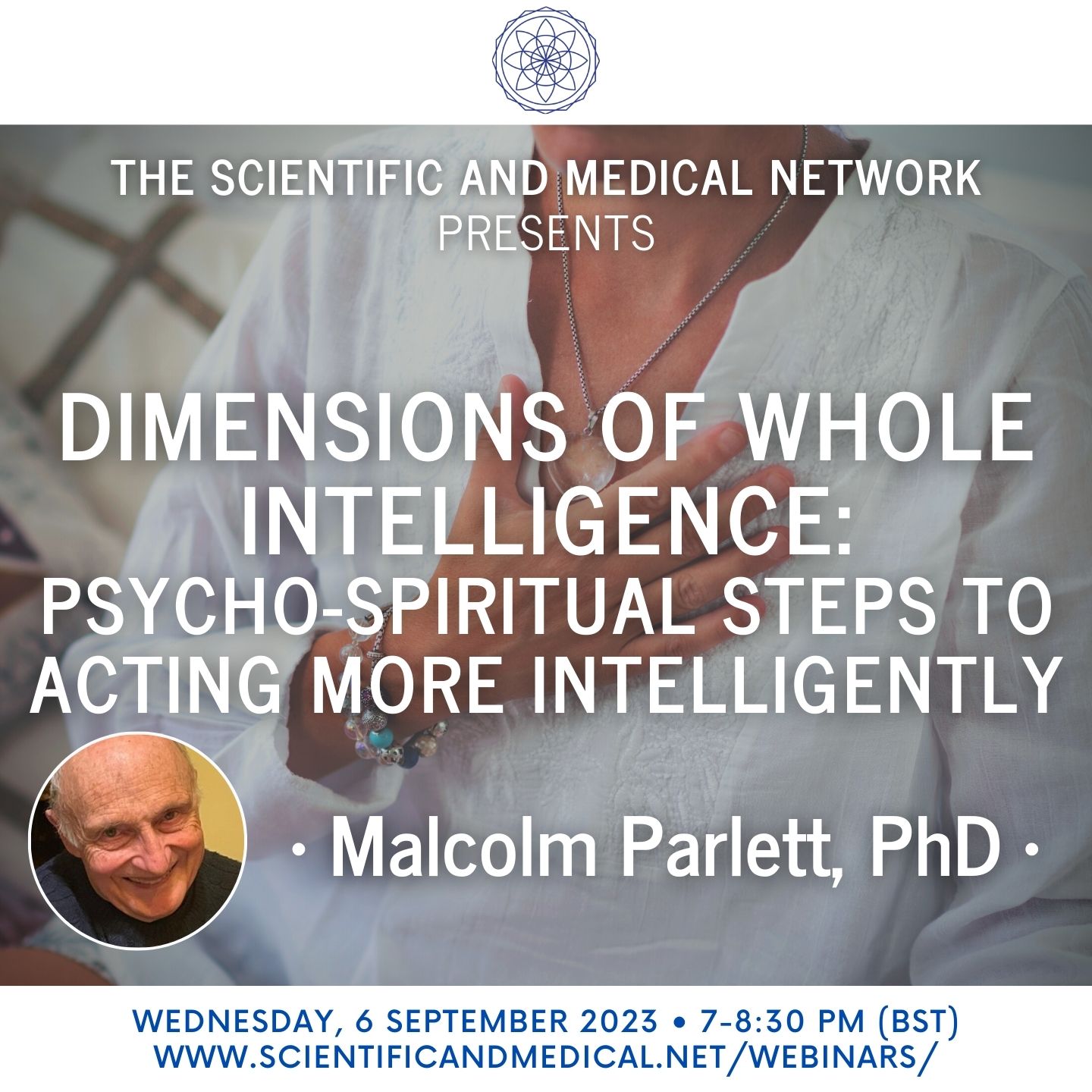
Malcolm Parlett, PhD – Dimensions of Whole Intelligence: Psycho-Spiritual Steps to Acting More Intelligently
How can we develop a new psycho-spiritual consciousness?
This presentation will include some personal history in connection with how the concept of Whole Intelligence originated. Ultimately, the project is fuelled by a recognition of the extreme urgency of the global crisis. Supporting human beings to act more intelligently, to find direction, and to stay emotionally and spiritually resilient becomes ever more important, given the immense problems and dilemmas of our time – including increased challenges to mental health.
Whole intelligence has a deliberately holistic and inclusive meaning, accommodating all kinds of human competence and capability that contribute to individuals, groups, and organisations acting intelligently. The adverbial form strikes us as a useful and down to earth approach: after all, supposedly very clever people can fail to act in clever ways; high intelligence in cognitive terms or in emotional EQ terms is no guarantee of more all-round capability, for instance as a national leader.
As a concept and practice framework, Whole Intelligence has derived from twenty-five years of clinical and organisational observation and inductive sense-making. In observing leaders, working with teams and communities, and exploring effective change processes in therapy and coaching, five specific areas of capability and human skilfulness have repeatedly stood out.
My colleagues and I think of them now as five critical dimensions of an integrated ‘Whole intelligence’ or constituents of all-round competence akin to the ancient Greek phronesis, usually translated as ‘practical wisdom’. They are linked together and mutually supportive of each other, and benefit through each of them being available together. They are summarised as follows:
Abilities to…
- Respond to situations flexibly, realising that there is value in preserving ‘wholeness’ and complexity: (
- Collaborate respectfully, realising that human beings are multiply interconnected:
- Access embodied knowing, realising that human beings have a host of non-verbal skills and that ‘living in one’s head’ has downsides:
- Operate mindfully, realising that human beings need to ‘recognise themselves’ more fully, humbly, and accurately:
- Experiment imaginatively, realising that most human beings have a prodigious capacity to learn, change, and evolve:
The presentation will explore how these five areas of human skilfulness make sense to people and widely resonate with many other strands of psycho-spiritual inquiry in circulation. They may provide an equivalent to an ‘intermediate technology’ in developing a new consciousness of the body, mind, and soul; a distinct support for mental health and for the existential tasks of living through revolutionary times.
They may also offer five recognisable – and necessary – perspectives on human lived experiences that may help to reanimate values and competences in danger of being lost in the torrents of technological change and heated up living conditions that human beings globally are contending with today.
•
About the speaker:
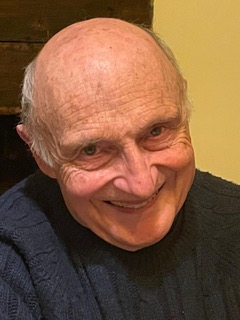

Dr Malcolm Parlett says: “In my working career there have been three phases, each pursuing a branch of psychology different in content, methodology, and epistemology. The first phase was in the Department of Experimental Psychology at Cambridge studying short term memory. I became sceptical regarding the ultimate value of my doctoral research. This prompted a change of direction. My second career phase began at MIT, where I made studies of students’ learning styles and pursued anthropological explorations of their academic milieu. I continued this work at the University of Edinburgh as a lecturer for five years, developing the approach of ‘illuminative evaluation’ – studying teaching and learning in a more anthropological fashion – as a counter to the remote statistical ways of evaluating educational success.
I then moved full-time to working as a consultant to colleges, universities, and educational foundations in both the US and the UK, and later in third world countries as well. The third phase began in 1975, when I experienced the gestalt therapy tradition first hand and was instantly impressed. Training in this quintessentially holistic approach led to working in a more active role with individuals, couples, and small groups. Long-term research interests in teaching and learning continued alongside editing the British Gestalt Journal, establishing training programmes, holding four visiting professorships, and supporting the professionalisation of psychotherapy in the 1980s. My gestalt therapy experiences – both as a student and later as a teacher – led to studying developmental changes.
This became the foundation for research into Whole intelligence that continues to the present time. My book, Future Sense: Five explorations of Whole Intelligence for a world that’s waking up (published in 2015) sparked international interest and currently the members of the Whole Intelligence Research Fellowship comprise consultants and therapists from five countries. Our aim is to bring the Whole Intelligence approach to a far wider audience, in the belief that – with a possibly imminent tipping point globally – Whole Intelligence studies can contribute to the necessary change in consciousness.”
TICKETS
Please note: This event is included in the Season Ticket.
All bookings will receive a link to view the RECORDING.
Speaker
-
Malcolm ParlettWriter
Dr Malcolm Parlett says: “In my working career there have been three phases, each pursuing a branch of psychology different in content, methodology, and epistemology. The first phase was in the Department of Experimental Psychology at Cambridge studying short term memory. I became sceptical regarding the ultimate value of my doctoral research. This prompted a change of direction. My second career phase began at MIT, where I made studies of students’ learning styles and pursued anthropological explorations of their academic milieu. I continued this work at the University of Edinburgh as a lecturer for five years, developing the approach of ‘illuminative evaluation’ – studying teaching and learning in a more anthropological fashion – as a counter to the remote statistical ways of evaluating educational success.
I then moved full-time to working as a consultant to colleges, universities, and educational foundations in both the US and the UK, and later in third world countries as well. The third phase began in 1975, when I experienced the gestalt therapy tradition first hand and was instantly impressed. Training in this quintessentially holistic approach led to working in a more active role with individuals, couples, and small groups. Long-term research interests in teaching and learning continued alongside editing the British Gestalt Journal, establishing training programmes, holding four visiting professorships, and supporting the professionalisation of psychotherapy in the 1980s. My gestalt therapy experiences – both as a student and later as a teacher – led to studying developmental changes.
This became the foundation for research into Whole intelligence that continues to the present time. My book, Future Sense: Five explorations of Whole Intelligence for a world that’s waking up (published in 2015) sparked international interest and currently the members of the Whole Intelligence Research Fellowship comprise consultants and therapists from five countries. Our aim is to bring the Whole Intelligence approach to a far wider audience, in the belief that – with a possibly imminent tipping point globally – Whole Intelligence studies can contribute to the necessary change in consciousness.”
Recent Book Reviews


Random Book Review


